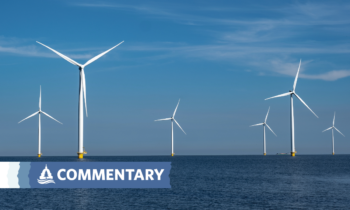
 The Trump administration is trying to kill the United States offshore wind industry behind closed doors.
Department of the Interior (DOI) Secretary Burgum has been leading the President’s playbook of undermining confidence in the U.S. renewable energy industry and giving unbridled support to the fossil fuel industry. His targeting of the offshore wind sector is of particular concern.
In December, Secretary Burgum issued abrupt directives halting construction for all offshore wind projects already under development along the East Coast. The stated justification was unspecified “national security concerns.”
This directive was in the form of peremptory “orders” to five separate offshore wind projects issued by the Bureau of Ocean Energy Management (BOEM), a DOI subagency. This order seemed to defy logic and the law. The permits for these projects had already been issued after careful review by BOEM, National Oceanic and Atmospheric Administration, the Department of Defense, Federal Aviation Administration, Coast Guard, Army Corps of Engineers, and the Environmental Protection Agency. The Trump administration did not disclose what new national security issues had been raised.
The administration’s efforts deserve serious scrutiny. These weren’t speculative proposals; these five projects represent over 5,800 MW of new energy capacity, enough to power millions of homes. They support tens of thousands of clean energy jobs, stand to save ratepayers hundreds of millions each year, and directly address electricity reliability risks in states desperate for new power supply. Halting them would heighten the risk of blackouts and further strain households and businesses by driving energy prices even higher and driving away investment in American offshore wind.
PEER Takes Action
In December, I wrote to members of Congress, noting that the administration lacks legal authority to “pause” these projects without Congressional authorization. I warned that allowing such an action to stand would establish a troubling precedent: future presidents could claim national security authority to target federal leases in any energy sector for political reasons, without meaningful oversight or justification.
PEER is demanding answers. We filed a series of Freedom of Information Action (FOIA) requests with DOI to investigate these actions. We asked whether and when DOI officials actually reviewed any classified national security assessments. We asked how the decision to “pause” the leases was cleared internally. We asked whether standard agency processes were followed before the announcement went public.
Those requests for transparency remain largely unanswered. We expect we will need to sue to get a response, and PEER is prepared to do exactly that.
Progress and Pushback
The good news is federal courts have pushed back, issuing injunctions allowing construction to continue on those five projects. Since then, other offshore wind projects have reached important milestones by delivering electricity to the New England grid and to Virginia homes.
However, uncertainty remains. The injunctions are temporary; the cases are still open and DOI has signaled plans to appeal. The administration is also appealing a separate December decision that ruled their Day One executive order halting offshore wind permitting as unlawful.
The administration is still escalating strategies against American offshore wind. On March 23, DOI announced an agreement with TotalEnergies to relinquish two offshore wind leases areas in exchange for a $928 million investment on various oil and gas energy projects. “Following their new investment, the United States will reimburse the company dollar-for-dollar, up to the amount they paid in lease purchases for offshore wind,” per DOI’s press release. In other words, taxpayers are subsidizing a state-sponsored buyout of the offshore wind industry. The administration is reportedly exploring similar deals with other developers, as well.
It’s critical to have transparency around major federal decisions with national consequences. New studies confirm the climate is warming faster than expected, sea level rise from climate change has been underestimated, and global biodiversity loss is accelerating. We need the administration to stop its attacks on offshore wind and restore it as a part of America’s energy future. We have numerous tools at our disposal to fight climate change – solar, wind, and preserving intact ecosystems – and we cannot afford to dismiss any of them.
PEER will continue to use every legal tool available to pursue transparency and accountability.
 Tim Whitehouse is the Executive Director at PEER.