
 In February 2025, the inappropriately-named “Department of Government Efficiency (DOGE)” abruptly terminated 420 employees of the U.S. Fish and Wildlife Service (USFWS), amounting to about 18% of the agency’s workforce. Their termination was an early example of the Trump Administration’s ready-fire-aim approach of firing workers without cause or regard to what services they provide and subsequently hiring some back when gaps in service become apparent to the public. The risk of illegal termination, along with the ill-treatment of remaining workers, is intended to sow fear and subservience to political masters in disregard to their agency’s mission, law, science, transparency, and public service.
As a former environmental officer for two federal agencies during the Bush II and Obama administrations, I have some appreciation of the difficult choices that mission-driven federal workers are being forced into – push back, acquiesce, or quit – and the stresses that such decisions create. Cruelty and chaos are intentional attributes of the “flood the zone” and “own the libs” tactics, designed to make one’s head spin, stay off-balance, and sink into despair.
The purpose of this commentary is not, however, to bemoan the latest travesty du jour. Rather, it is to offer a strategy for maintaining personal resilience to resist over the remainder of this administration. In identifying this strategy, I call your attention to an unassuming USFWS marine biologist named Rachel Carson (1907-1964) who became senior editor at that agency.
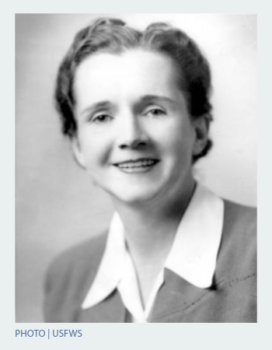 Rachel Carson is perhaps best known for her book Silent Spring, which documents the danger of pesticides to ecosystems and human health. She wrote Silent Spring while living just five miles from PEER’s current headquarters. She lived in a modest bungalow near a stream called the Northwest Branch where she liked to walk.
At a time when there were few females in science, she had to fend off patriarchal attacks by the powerful chemical industry. Her persistent advocacy is credited with sparking the modern environmental movement, ultimately leading to the passage of landmark environmental legislation during the Nixon administration.
Ironically, Ms. Carson was diagnosed with breast cancer while writing Silent Spring. Despite her declining health, she continued writing and advocating until her end.
The gifts that Ms. Carson’s life and legacy have given us, however, are not limited to her modeling the qualities of courage, commitment, passion, and truth. Although not as widely celebrated as her work on pesticides, Rachel Carson also wrote about nurturing children’s sense of wonder as they experience the natural world. Her essay, “The Sense of Wonder,” was first published in July 1956 in Woman’s Home Companion under the title “Help Your Child to Wonder.” In that essay, she wrote, “I sincerely believe that for the child, it is not half so important to know as to feel. If facts are the seeds that later produce knowledge and wisdom, then the emotions and the impressions of the senses are the fertile soil in which the seeds must grow.”
Carson adopted her grandnephew Roger and delighted in taking him on nature outings in Maine, where she spent many summers. In “The Sense of Wonder,” she wrote:
“One stormy autumn night when my nephew Roger was about twenty months old I wrapped him in a blanket and carried him down to the beach in the rainy darkness. Out there, just at the edge of where-we-couldn’t-see, big waves were thundering in, dimly seen white shapes that boomed and shouted and threw great handfuls of froth at us. Together we laughed for pure joy—he a baby meeting for the first time the wild tumult of Oceanus, I with the salt of half a lifetime of sea love in me. But I think we felt the same spine-tingling response to the vast, roaring ocean and the wild night around us.”
She had wanted to expand upon her essay but died before she could do so.
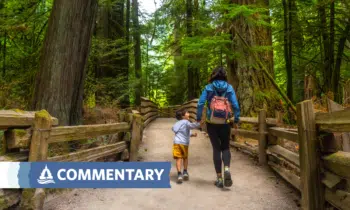
Rachel Carson reminds us that our connection with our precious blue planet is mutual. That is, just as we take action to protect the planet, so we can draw strength and support from it. In particular, if you have children in your life through family or community, do yourself a favor and take them into nature. Carson understood how important doing so is, not just for the sake of the next generation, but for healing adults as well. Adults can share in the uninhibited curiosity, awe, and nonjudgement that kids exhibit. And being with kids in natural settings helps us adults take the long view of becoming good ancestors.
For further information about Rachel Carson’s life, see this article or this video. Many resources for exposing children to nature can be found at the Children and Nature Network.
 Keith Kozloff is an environmental economist previously with the federal government.