
FOR IMMEDIATE RELEASE
Thursday, March 26, 2026
CONTACT
Chandra Rosenthal (303) 898-0798 [email protected]
As Rangeland Health Declines, BLM Stops Monitoring
Science-Based Land Management Falls Victim to Trump Budget Cuts
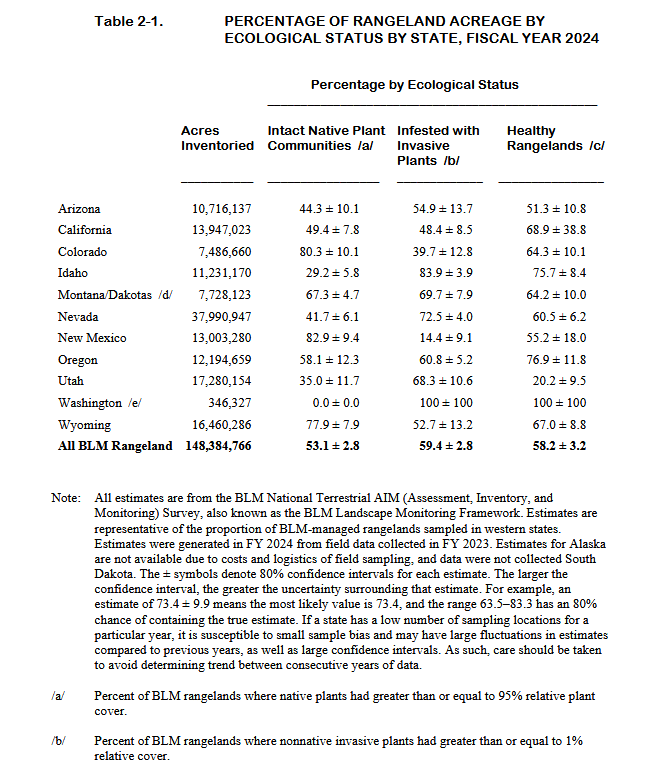
Washington, DC — America’s vast western rangelands are in sharp decline, yet the Trump administration no longer wants to monitor the health of these landscapes, according to Public Employees for Environmental Responsibility (PEER). Statistics compiled from scientific assessments by the U.S. Bureau of Land Management (BLM) show that the percentage of BLM lands classified as healthy dropped from 72% in 2022 to 58% in 2024, with future evaluations in doubt due to budget cuts.
Since 2011, BLM has operated the Assessment, Inventory, and Monitoring (AIM) program. It has been a cornerstone of science-based stewardship for millions of acres of federal rangelands, providing critical data on land health, invasive species, and native plant communities. BLM field crews collect repeatable, standardized measurements on randomly selected plots, allowing BLM to assess conditions across entire states and regions. AIM data are essential for detecting trends, planning adaptive management, and evaluating grazed lands.
Cuts to AIM, including its reported complete elimination in Wyoming for 2026, threaten to dismantle federal land monitoring capabilities. BLM has already stopped tracking data in the Dakotas for its annual Public Land Statistics Report because of low sample sizes in North Dakota and no sampling in South Dakota. In just the first year of Trump’s second term, BLM lost nearly one-fifth of its entire staff, leading to steep reductions in the number of scientists and technical specialists available to conduct and analyze AIM surveys.
“Effective public lands management begins with understanding land health,” said PEER’s Western Lands and Rocky Mountain Advocate Chandra Rosenthal. “Without the data the AIM program provides, BLM is flying blind.”
Recent AIM reports show troubling declines in land health. According to the most recent Public Lands Statistic report from June 2025, only 53% of BLM lands have intact native plant communities, while 59% of acres are affected by invasive plants.
“These numbers reveal a landscape under pressure,” added Rosenthal. “Monitoring isn’t the problem – it’s the solution. We need to know what’s happening on the ground to respond effectively.”
PEER reached out to BLM to understand the status of the monitoring program and completed the two-page meeting request form. In response, BLM said it could not schedule a briefing meeting at this time due to a lack of internal approvals and would need to delay until those are in place.
Without AIM, BLM loses its ability to measure and understand changes in land health. AIM data are increasingly used for Land Health Standards evaluations, grazing permit renewals, and National Environmental Policy Act analyses. Without monitoring, decisions regarding land health become harder to understand, more difficult to manage, and less defensible in court.
###
Review AIM data from 2022-2024
See the AIM section of the 2024 Public Lands Statistics Report
Note Trump retreat on landscape health
Look at spreading land abuse from overgrazing
PEER protects public employees who protect our environment, natural resources, and public health. We support current and former environmental and public health professionals, land managers, scientists, enforcement officers, and other civil servants dedicated to upholding environmental laws and values across federal, state, local, and tribal governments.