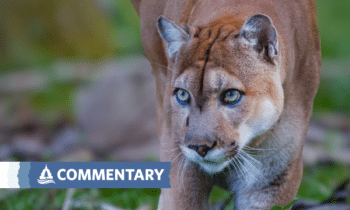
 A North Atlantic right whale mother and her calf surface off the Georgia coast. A Florida panther pads silently through a cypress swamp, one of fewer than 100 left alive. In Alaska’s Cook Inlet, a small, isolated group of beluga whales call to one another in waters their ancestors have inhabited for thousands of years.
These are not symbols. They are the living measure of whether humans will continue to destroy the wildlife around them and drive many to extinction.
National Endangered Species Day reminds us what’s at stake. But this year, the reminder arrives with added urgency: the systems designed to protect these animals — and thousands like them — are being systematically dismantled. The Trump administration and many state governments are abandoning most efforts to protect the natural world around us.
This is bad news for the most vulnerable wildlife. Wild mammals comprise just 5% of the world’s biomass; the rest is humans, livestock, and pets. Further weakening of the Endangered Species Act would doom many more species to extinction.
The Law Is Only as Strong as Its Infrastructure
The Endangered Species Act is among the most powerful environmental laws ever written. But its power depends entirely on the people and processes behind it: scientists collecting data, agency staff reviewing projects, environmental reviews surfacing risks, and public employees willing to raise alarms when something goes wrong.
Weaken any part of this foundation, and the law fails. Not loudly, but slowly — long before the consequences show up in population counts.
The North Atlantic right whale knows this too well. With fewer than 370 remaining, every individual matters. Their survival depends on federal decisions made daily: shipping lane speed limits, fishing gear regulations, offshore energy siting. Each decision requires scientists with data, reviewers with independence, and enforcement with teeth. Remove any piece of that chain, and whales die — not from one catastrophic choice, but from the slow accumulation of harms.
What’s Being Weakened Right Now
At PEER, we work on the infrastructure of wildlife and habitat protection — the people, the resources, and the government institutions that make the law function. What we’re seeing is alarming.
Career scientists and civil servants face mounting pressure, with civil service protections under direct threat. Major reorganizations at the Forest Service and U.S. Geological Survey are gutting the institutional expertise that conservation depends on. Key endangered species decisions are increasingly made behind closed doors, including through the Extinction Committee — a process PEER has flagged for its lack of transparency. Environmental enforcement is declining. Agencies are understaffed. Decisions on public lands continue to sideline legal protections.
For the Florida panther, this is not abstract. Their recovery depends on habitat connectivity — protected corridors through private and public land that require constant federal coordination, biological review, and enforceable land-use decisions. As experienced staff are pushed out and environmental reviews are expedited or eliminated, those corridors become vulnerable. The panther doesn’t know a review was skipped. It only knows the road wasn’t managed, the development wasn’t checked, the population that was almost recovered suddenly isn’t.
These aren’t isolated failures. They reflect a deliberate pattern: weaken the systems first, and the protections collapse on their own.
Why This Translates Directly to Species
Wildlife depends on decisions — thousands of them, made daily across federal agencies. Whether a project gets approved. Whether risks are properly assessed. Whether protections are enforced. Whether new threats are caught early.
The Cook Inlet beluga whale population has declined more than 80% since the 1980s. Today, roughly 300 remain — and they are not recovering. Their survival hinges on precisely the kind of careful, science-driven federal oversight now under threat: habitat designations, industrial permitting, and noise and pollution controls in a waterway increasingly coveted for development. These whales live in one place. There is no fallback population. When the system fails them, there is no second chance.
When the people making critical decisions lack data, independence, or support, the outcome is predictable: fewer safeguards, more risk, less protection. Not in theory. In practice.
This Is the Moment That Matters
Last month offered a warning sign of how bad things might get if we don’t constantly push back. The House pulled a bill that would have delayed species listings, expanded allowable harm to wildlife, and narrowed critical habitat designations. It was withdrawn after bipartisan opposition. It is a sign of how our systems can come under threat.
We don’t lose species in one sweeping decision. We lose the systems that protect them first — piece by piece, until there’s nothing left to enforce.
That’s what makes this moment different from past threats to the Endangered Species Act. The right whale, the panther, the Cook Inlet beluga — their existence is dependent on a thread in a web of laws held together by scientists, government officials, private sector actors, and political will. Pull enough threads quietly, and the web falls.
Protecting wildlife today means protecting the scientists who do the work, ensuring decisions are transparent and science-based, maintaining strong environmental review, and demanding that these systems are funded and allowed to function.
At PEER, this is where we focus — because when the systems hold, the right whale, the panther, and the beluga have a chance.
And when they don’t, the consequences aren’t reversible.
 Tim Whitehouse is the Executive Director at PEER.