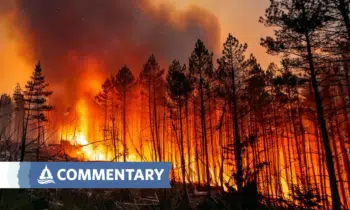
 By all metrics, the upcoming 2026 fire season in the parched West looks like it may be one of the worst ever — with massive, dangerous forest fires. The Southeast has already seen several forest fires, with record numbers in Florida and Georgia.
Fire response is more than just fighting the flames. Another key aspect of responding to forest fires is communicating information about them to the public. Each federal agency has certified fire incident communicators, who are the communications specialists who are tasked with accurately relaying information about fires via television and radio, and who speak to reporters. Information about individual forest fires can change rapidly and communications from certified fire incident communicators simplify what firefighters are telling them into plain and understandable messages for the public. The plain language information shared with the public by certified fire incident communicators is critical in the event the fire spreads unexpectedly, endangering people and homes and requiring evacuations.
Losing Fire Communications Experts
Unfortunately, Department of the Interior (DOI) Secretary Burgum now requires all Interior agency communications personnel to report to the Secretary’s office rather than their own agencies, which has led to numerous experienced fire incident communicators being reassigned to other jobs. Their expertise is not valued, which is exactly the wrong message the country needs to hear as we approach a heavy and dangerous fire season.
PEER has learned through anonymous sources that the consolidation of Interior’s communications personnel has been carried out haphazardly — without new position descriptions or training for new positions, and numerous other problems. Standard, long-accepted federal personnel management practices are simply ignored by the Trump administration, leaving civil servants in the dark and with cratering morale.
Interior leadership’s approach to communications staff appears to be “plug and play,” that is, trying to make generalists out of everyone and plugging staff into new positions. This move takes away the autonomy of the consolidated staff because their subject matter expertise is no longer valued. It is part of the administration’s broader approach of getting rid of the so-called “Deep State,” which has led to the displacement of civil servants with deep backgrounds and expertise. Is that a good way to run an organization? I sincerely doubt it.
At least five fire communications staffers have been removed and placed in other jobs by DOI communications leadership, and several others have retired earlier than expected or found other jobs, seeking to get away from the uncertainty of constant change. The result of this careless approach to fire incident communications is that if a large fire breaks out on Interior lands, such as at a national park, communications on the fire will likely be confusing.
A Dangerous Communications Breakdown
There is no new detailed plan for fire communications under Interior’s new system, and existing incident communications resources and guidance on key issues are not being maintained. Permissions to post information on the key interagency incident website, inciweb.gov, has been granted slower than usual so far this year.
The consolidation of all the communications staffers under Burgum’s office has been very inefficient, with constant confusion resulting in reduced productivity. Staff are trying to do the right thing under difficult circumstances.
The mismanagement of fire communications could result in members of the public being hurt or worse due to inadequate or unclear messaging. Of course, we hope that doesn’t happen. But, if it does, it will be clear where the blame lies — with this administration.
 Peter Jenkins is PEER’s senior counsel.